QUICK SUMMARY
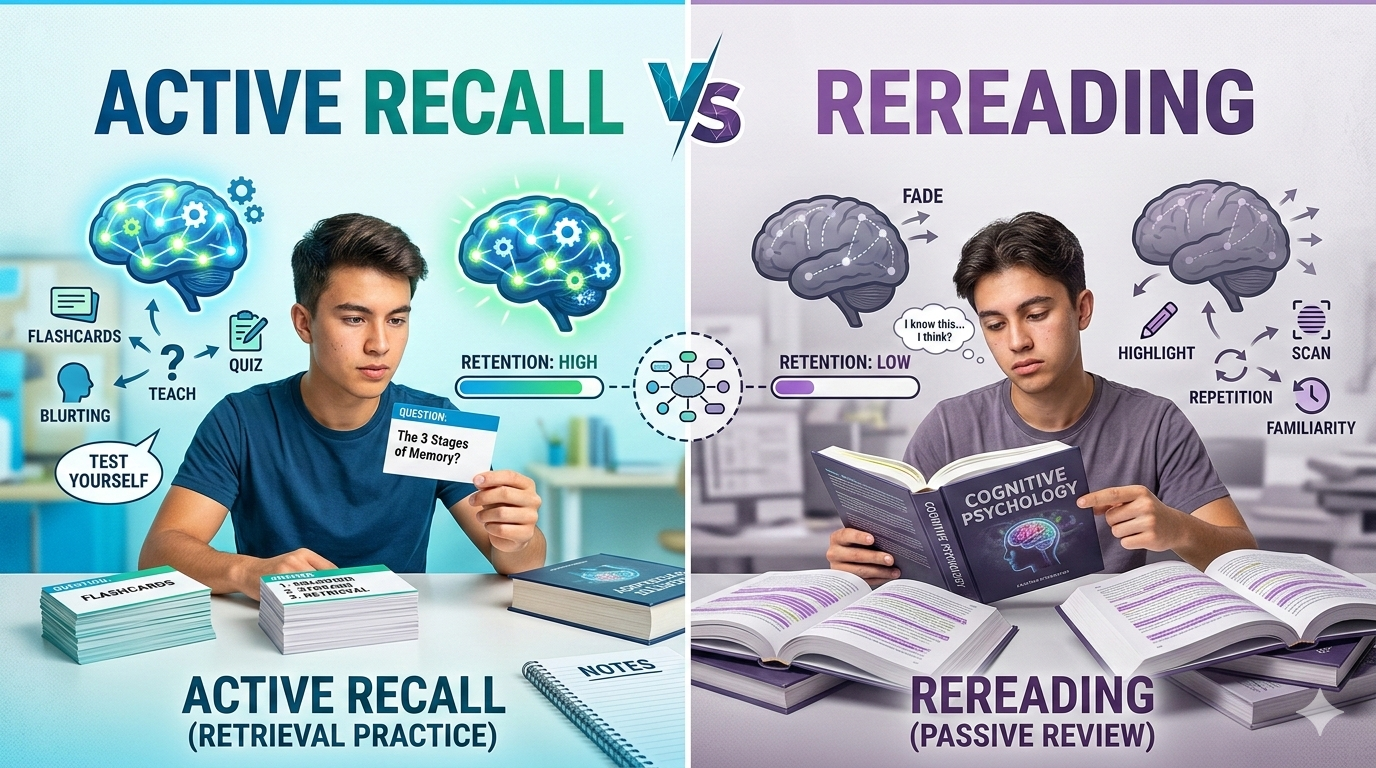
If you’re wondering whether active recall vs rereading leads to higher exam scores, the evidence is clear: retrieval practice consistently outperforms passive review.
Most students spend hours rereading textbooks and highlighting notes, believing that more time equals higher marks. It feels productive and like progress. But in the exam hall, it disappears.
Why?
Because rereading builds recognition, not recall.
When you reread, your brain says, “I’ve seen this before.” That sense of familiarity creates confidence. But exams do not test familiarity. They test whether you can retrieve information from memory without looking.
WHO THIS GUIDE IS FOR
This guide is for:
- High school students preparing for final board exams
- IGCSE students (Year 9–11), AS & A-Level students
- Cambridge (CAIE), Edexcel, AQA, and GCSE boards
- Students aiming for A or A* grades
- You’re stuck at B/C and want a breakthrough
- You study hard but forget the answers in exams
- You want clarity on what actually improves exam scores
Not for:
- Students looking for “quick hacks” the night before the exam
- Students who believe rereading notes is enough
- Anyone unwilling to test themselves without looking at the answers
- Students who want motivation without changing their study methods
TABLE OF CONTENTS
- Practice vs. Rereading
- MEMORY Retrieval Loop
- How Study Methods Impact Exam Scores
- What High-Scoring Students Do Differently
- Common Misconceptions About Active Recall vs Rereading
- How to Measure If Your Revision Method Is Working
- Final Thoughts
- Frequently Asked Questions
Active Recall vs Rereading: What Actually Improves Exam Scores
The difference between passive rereading and active practice represents important findings in modern education. 80% of students rely on rereading as their “go-to” strategy. Cognitive science shows this approach is very ineffective for long-term retention and complex understanding.
Rereading creates a “fluency illusion,” making us think we understand something well. However, retrieval practice means trying to remember information without looking at notes. It actually helps our brains learn better. This method, known as the “testing effect,” helps us focus on recalling information instead of just reading it.
Why Rereading Feels Effective (But Isn’t)
The psychological mechanism at play here is called Fluency. When information is easy to process, our brains shortcut to the conclusion that the information is also easy to remember.
For Example: Passive reading is like watching someone else lift weights at the gym. You understand the movement, you see how it’s done, but your own muscles aren’t getting any stronger. To get the “exam muscles,” you have to lift the information yourself through Active Recall.
The Familiarity Illusion
Familiarity involves the front part of the parahippocampal area of the brain, while true recall occurs in the hippocampus. When a student rereads, they often experience a sense of “I know this,” which leads to cursory processing.
This is a problem because it hides gaps in their knowledge. A student might recognize a term when they see it (familiarity), but may not be able to explain the idea or use it in a different situation (recall) during an important exam.
MEMORY Retrieval Loop
Below are step-by-step framework that converts passive revision into exam-ready recall. These memory retention strategies strengthen long-term recall rather than short-term recognition.
The Memory Formula
Memory Strength ∝ Retrieval Effort × Spacing × Application
The more effort you put into recalling information, spacing it over time, and applying it in exam-style questions, the stronger your long-term retention becomes.
Step 1: Close & Recall
What to do:
- After reading a topic, close your notes and try to write or speak everything you remember.
- Use past paper questions, flashcards, or the “blurting” method.
Why it works:
- Forces retrieval from memory rather than recognition.
- Strengthens neural pathways (the testing effect).
Example:
I once had a student who “knew” the Periodic Table but couldn’t name the first 10 elements on a blank page. Once we started “closing the book,” his recall speed tripled in two weeks.
Step 2: Identify Gaps & Target Weaknesses
What to do:
- Compare what you recalled with your notes.
- Highlight gaps, misconceptions, or missing examples.
Why it works:
- Retrieval exposes weak spots you didn’t know existed.
- Prevents the illusion of knowledge created by rereading.
Example:
In IGCSE Chemistry, several students consistently forgot acid-base reaction equations during recall. Targeting these gaps increased their accuracy from ~60% to 85% on past papers.
Step 3: Active Application
What to do:
- Immediately apply recalled knowledge in different contexts.
- Solve past paper questions, problem sets, or scenario-based questions.
Why it works:
- Exam questions rarely repeat exactly what’s in the notes.
- Application strengthens retrieval under pressure.
Example:
We call this “The Pressure Test.” If you can’t use the information to solve a problem, you haven’t actually learned it. You’ve just memorized a soundbite.
Step 4: Spaced Review & Repeat
What to do:
- Review topics after 1 day, 3 days, 7 days, and then 14 days.
- Repeat Steps 1–3 for long-term retention.
Why it works:
- Spaced repetition prevents forgetting and builds durable memory.
- Reinforces recall pathways instead of passive familiarity.
Example:
Across multiple A-Level batches, students who spaced their recall consistently retained 70–90% of knowledge compared to ~40% for those who reread.
How Study Methods Impact Exam Scores
The relationship between study methodology and exam scores is a central focus of educational psychology. Controlled memory studies on retrieval practice show that the most popular study methods are rereading and highlighting. These are the least effective for long-term retention and high-stakes performance.
Conversely, methods that introduce “desirable difficulties,” such as retrieval practice and spaced repetition, lead to higher marks by aligning the revision process with the cognitive demands of the examination environment.
Choosing the right effective revision techniques directly impacts how well students perform under exam pressure.
Comparison Table
| Method | Trains Recall? | Builds Long-Term Memory? | Works Under Exam Pressure? |
| Rereading | ❌ No | Low | ❌ Rarely |
| Highlighting | ❌ No | Very Low | ❌ No |
| Active Recall | ✅ Yes | High | ✅ Yes |
| Spaced Repetition | ✅ Yes | Very High | ✅ Yes |
How Misaligned Revision Affects Marks
Misalignment occurs when the way a student studies does not match the way they will be tested. This discrepancy is a primary driver of lower-than-expected marks.
- Input vs. Output: Rereading is an “input” activity, whereas an exam is an “output” activity. If 90% of study time is spent on input, the student is untrained for the output required to earn marks.
- Lack of Feedback: Passive methods provide no feedback on what is actually known. A student may spend hours rereading a chapter they already understand while neglecting a difficult concept they have forgotten, simply because they haven’t tested themselves to find the gap.
- Context Dependency: A passive study often tethers information to the specific order of the textbook. If an exam question presents the concept in a new context or a different order, the student may fail to recognize it.
Simple Adjustments That Yield Big Results
Shifting from passive to active study does not require more time, but a change in how that time is utilized. Small adjustments in strategy can lead to substantial increases in exam scores.
1. The “Read-Recite-Review” Method
Instead of rereading a chapter, students should read a small section. Close the book, and recite the main points aloud or write them down. Only then should they review the text to see what they missed. This is the key to ensuring they will be able to recall information when needed.
2. Spaced Repetition over Cramming
Cramming (massed practice) can lead to high scores on immediate tests but results in rapid forgetting. By spacing out study sessions like reviewing a topic after one day, then three days, then a week. It helps students exploit the “spacing effect,” which hardens the memory against the effects of exam stress.
3. Interleaving Topics
Interleaving involves mixing different types of problems or topics in a single session. While this feels more difficult and “messy,” it trains the brain to distinguish between different concepts. This skill is essential for exams where questions are often randomized.
4. Low-Stakes Self-Quizzing
Utilizing the questions at the end of a textbook chapter or creating flashcards are simple ways to implement retrieval practice. The act of “struggling to remember something actually increases the strength of that memory.” Even if the student gets the answer wrong, the attempt itself makes the subsequent review of the correct answer more effective.
What High-Scoring Students Do Differently
Analysis of examiner reports from major bodies such as AQA, OCR, and Pearson Edexcel reveals different patterns among high-achieving students:
- High-scoring candidates show “synoptic link” capabilities. The ability to connect different parts of a syllabus to answer a single complex question
- In the humanities, this manifests as nuanced historiography or literary criticism that goes beyond rote memorization.
- In STEM subjects, top students show high mathematical fluency, often showing clear, logical derivations rather than just the final answer.
Examiners frequently note that the highest marks are awarded to those who use technical vocabulary precisely and provide “evaluative” rather than merely “descriptive” content.
Board-Specific Question Styles (CAIE, Edexcel, AQA, OCR)
Different exam boards have unique styles:
CAIE (Cambridge Assessment International Education): Often emphasizes deep linear knowledge and rigorous terminal examinations.
Edexcel: Known for a strong emphasis on application-based questions, particularly in its BTEC and International A-Level suites.
AQA: Frequently utilizes structured data-response questions in social sciences.
OCR: Often praised for its focus on practical science skills and “working scientifically” components.
Common Misconceptions About Active Recall vs Rereading
Experimental studies on the testing effect show that active recall is significantly more effective than passive review methods like rereading. Below are the common misconceptions about active recall vs rereading and how to fix them:
“I Can Just Re-read to Remember”
Many students think that re-reading a textbook chapter multiple times helps the information “sink in.” The ease of reading the text during subsequent attempts is known as the “fluency illusion.” While your brain recognizes the words, this does not equate to true understanding or retrieval.
How to Fix it:
Instead of rereading, use “Free Recall”: After reading a section, close the book and write down everything you remember on a blank sheet. Only consult the book to check for missed details. This active recall strengthens memory retention.
“Flashcards Are Enough Without Testing”
Students often believe that simply owning or looking at a deck of flashcards constitutes active recall. They may flip through the cards quickly, looking at the answer almost immediately after seeing the prompt.
How to Fix it:
Use the “Leitner System” or digital equivalents like Anki. You must commit to an answer before flipping the card. If you get it wrong, the card must return to the most frequent review pile. High-scoring students use flashcards to test “application” rather than just “definition.”
“Spaced Repetition Isn’t Necessary”
“Cramming” or massed practice is a viable way to learn. Students often feel that if they spend six hours studying a single subject the day before a test, they have “learned” it.
How to Fix it:
Implement a “1-3-7-30” schedule. Review new material after one day, then three days, then one week, and finally one month. Each review session should involve active recall (testing yourself) rather than just looking at notes.
How to Measure If Your Revision Is Working
If you’re unsure how to revise for exams, your results on past paper questions will reveal whether your method is working. To evaluate any single revision session, ask:
4 Self-Testing Questions
1: Can I explain this to a 10-year-old? (Understanding)
2: Can I recall the 5 main points without looking? (Memory)
3: Did I get more marks on this practice question than last time? (Application)
4: Am I using active methods (testing) rather than passive ones (reading)? (Methodology)
Tracking Past Paper Accuracy
To know if your revision is working, you should maintain a log of your scores across multiple papers from the same exam board. This is often referred to as “summative self-assessment”. If your revision is effective, you should see a steady increase in the percentage of marks gained.
A key indicator of progress is the reduction of “unforced errors”. These mistakes were not made because of a lack of knowledge, but due to a misunderstanding of the mark scheme.
By marking your own work using official examiner reports, you develop “metacognitive monitoring.” It allows you to identify exactly which topics require further “interleaving” (mixing different subjects) and which have been successfully moved into long-term memory.
Weekly Benchmarking System
Long-term progress is best measured by comparing performance across several weeks rather than day-to-day. Because of the “forgetting curve,” information that seems clear immediately after a study session may vanish within 48 hours if not properly consolidated.
To ensure your revision is working:
- Weekly Benchmarking: Take a short quiz or answer one high-mark exam question every Sunday on a topic you revised two weeks prior.
- Trend Analysis: Use a spreadsheet to graph your mock grades over two months. A “plateau” in grades suggests that your current method has reached its limit and you need to switch to more “desirably difficult” techniques like “elaborative interrogation”.
- Confidence Mapping: Rate your confidence on a scale of 1–10 for each sub-topic in your syllabus. Compare these ratings every three weeks. If your “low-confidence” topics shift to the “high-confidence” end of the spectrum. Your revision plan is successfully addressing your weaknesses.
Final Summary
So does active recall beat rereading? Yes, because exams test recall, not recognition.
If you’re serious about improving your exam scores, the shift starts with how you revise. Move away from rereading. Start training retrieval. Close your notes. Recall from memory. Identify gaps. Apply through past papers. Repeat with spacing.
This is the approach we use with our students at The Brilliant Brains. The focus isn’t on studying longer. It’s on building exam-ready memory through deliberate retrieval practice. Ultimately, the study methods that improve grades are the ones that train retrieval, not repetition.
Frequently Asked Questions
Is highlighting enough?
No. Highlighting helps identify important content, but it does not train you to produce answers under exam conditions.
How do toppers actually revise?
They test themselves regularly, use past papers early, track mistakes, and revise using spaced repetition. Their revision prioritises recall and application rather than passive rereading.
Why do I forget everything in exams?
Rereading creates recognition, but exams require recall under timed pressure. Without practicing retrieval and exam-style questions, memory performance drops during tests.
What is the best revision technique?
The most effective revision method is active recall combined with spaced repetition and past paper practice. This approach strengthens long-term retention, improves recall speed, and aligns revision with how exam boards assess answers.
3 Comments
IGCSE Revision Tips: How High-Scoring Students Actually Revise – The Brilliant Brains
March 15, 2026[…] Techniques like active recall consistently outperform passive methods such as rereading notes. If you want a deeper explanation of why this works, read Active Recall vs Rereading: Which Improves Exam Scores? […]
Why Revision Tips for Students Often Fail (And What Works Instead) – The Brilliant Brains
March 29, 2026[…] Exam boards do not primarily reward memory. They reward the ability to use memory under controlled, timed conditions in response to specific instructions. A student who knows every fact in the textbook but cannot structure an evaluative argument will not score as highly as a student with less content knowledge who can construct one. This is central to why active recall consistently outperforms re-reading in exam score outcomes. […]
The Biggest Revision Myths Parents & Students Believe (And the Truth) – The Brilliant Brains
April 6, 2026[…] Active recall is the single most research-supported revision technique available. Practising retrieval just one time doubled long-term retention, and repeated retrieval produced a 400% improvement in retention relative to studying alone. […]