A-Levels vs. IB: Which Is Right for You?
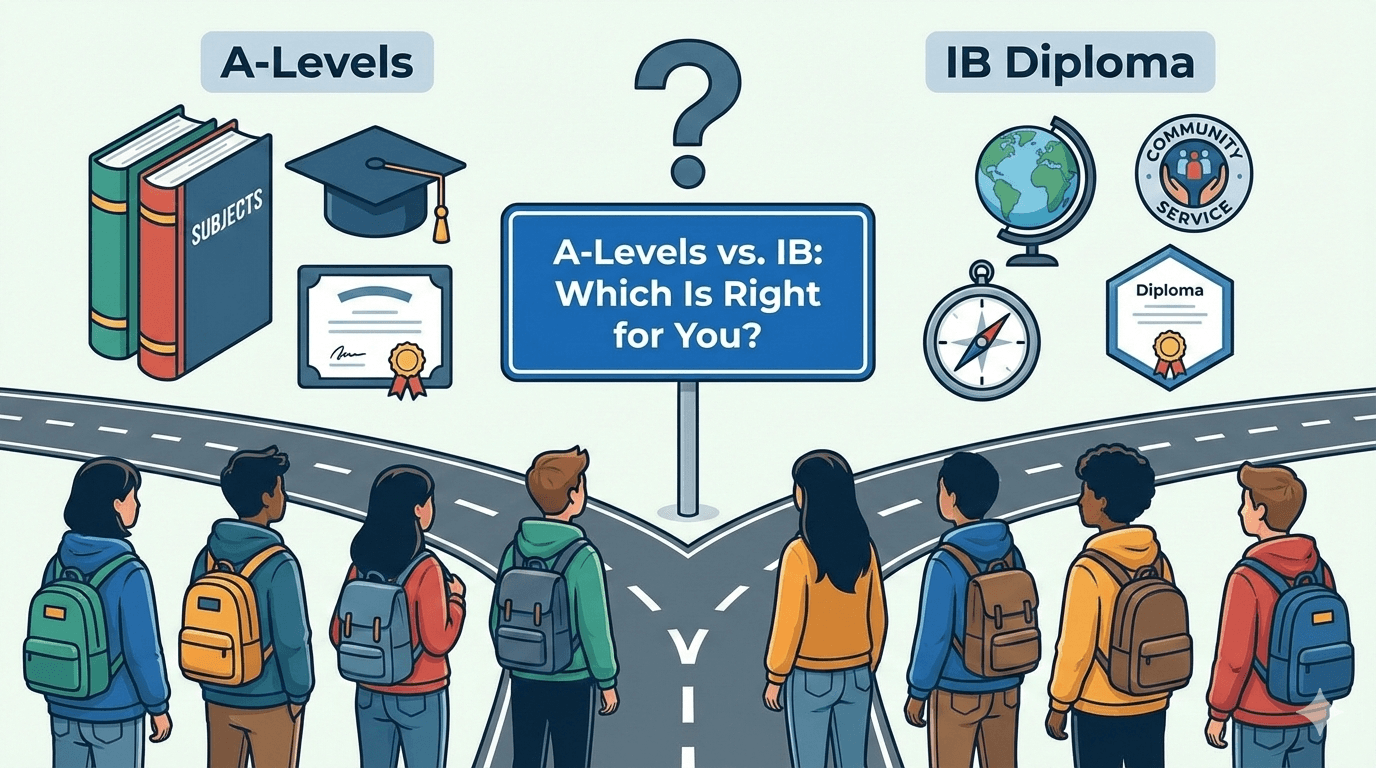
Choosing between A-Levels vs. IB can feel tough, especially when your future university choices, career paths, and learning experience depend on it. As a student (or parent), you might be thinking, “Which program will make me successful?” Which one suits my strengths? Which one keeps doors open?
In this guide, we walk you through the real differences between the International Baccalaureate vs A-Levels, not just what’s written in brochures. We consider learning styles, daily workload, personality fit, and what each of the pathways prepares you to do.
IB Curriculum vs A-Levels: Hidden Differences That Impact Student Performance
One of the biggest differences between the IB curriculum and A Levels is the philosophy behind how students learn.
1. Depth vs. Breadth
- A-Levels allow students to specialize deeply, usually choosing three subjects. This is ideal for the learners who already enjoy science, business, or humanities.
- The IB Diploma requires six courses in various categories, including languages, sciences, humanities, math, and arts.
This breadth means students develop strong cross-disciplinary thinking, while depth in A-Levels helps learners build subject mastery early.
2. The Role of Core Components
TOK, CAS, and the Extended Essay are all part of the IB. They build by creating research, reflection, and real-world experiences. A-Levels have fewer structured requirements, though many schools offer the EPQ to build similar research skills.
3. Learning Style & Skill Development
Students who enjoy independent research or reflective writing often thrive in the International Baccalaureate (IB). Meanwhile, those who prefer structured syllabi and clear exam-focused paths usually do well in A-Levels.
How A-Levels vs IB Shape Learning Skills for University Success
Universities care about skills as much as grades. The choice between A-Levels and the IB Diploma can influence the kind of academic habits you develop before university.
A-Level Skills:
- Analytical expertise in chosen subjects
- Exam strategy and precision
- Strong foundations for specialised degrees (e.g., Medicine, Engineering, Law)
A-Levels are excellent preparation for students who plan to enter fields requiring deep knowledge early on.
IB Diploma Programme Skills:
- Critical thinking (thanks to Theory of Knowledge)
- Academic research (via Extended Essay)
- Time management & balance (juggling six subjects + CAS)
- Global awareness from the IB’s international framework
According to the 2016 Universities UK Report, IB students are more likely to be enrolled in top universities globally and show stronger preparedness for research-based learning.
Why Skills Matter
When choosing between IB and A Levels, it’s worth considering how each pathway aligns with your long-term academic goals. For example:
- Students aiming for competitive US colleges often benefit from the IB’s holistic structure.
- Students targeting UK universities may prefer the focused mastery of A-Levels.
IB vs A Levels Based on Personality & Learning Strengths
Every student is different, and your personality plays a major role in whether A-Levels vs. IB is a better fit.
Choose A-Levels if:
- Like specialising early
- Prefer fewer subjects and more structured exam preparation
- Learn well with clear guidelines and linear coursework
- Feel confident diving deeply into specific fields like math, biology, or psychology.
Choose the IB Diploma Programme if:
- Enjoy exploring different subjects
- Prefer mixed assessment styles (essays, orals, projects, exams)
- Like making connections across topics
- Prefer collaborative learning and reflective writing
- Enjoy creative or community-driven projects (CAS)
Day-to-Day Life in A-Levels vs IB Diploma
While brochures compare curriculum and assessment, few discuss what daily life actually looks like. Yet for families choosing between A-Levels vs IB, this is one of the most important considerations.
A-Levels:
Students typically focus on 3–4 subjects, meaning:
- Fewer classes per day
- More time for independent revision
- A predictable schedule
- Heavier intensity in your chosen subjects
This structure suits students who thrive with repetition and subject immersion.
IB Diploma Programme:
IB students balance six subjects plus core components:
- Manage TOK assignments
- Work on CAS activities
- Conduct research for the Extended Essay
- Prepare for internal assessments throughout the year
It’s a busy, dynamic program and requires consistent organization.
A-Level Subject List vs IB Subject Groups
Parents often ask, “Which program keeps more university pathways open?” Let’s compare the flexibility of the A-Level subjects list vs. the IB subject groups.
A-Levels:
Students choose 3–4 subjects from categories like
- Sciences
- Mathematics
- Humanities
- Arts
- Social Sciences
You can specialize early, for example, choosing chemistry, biology, and math for medicine.
IB Subject Groups:
IB requires one subject from each group:
- Language & Literature
- Language Acquisition
- Individuals & Societies
- Sciences
- Mathematics
- The Arts (or an additional subject from another group)
This structure ensures a well-rounded academic profile.
Which Offers More Flexibility?
- A-Levels offer flexibility within your chosen field.
- The IB Diploma offers flexibility across fields if you’re unsure what to pursue next.
Consider Global Recognition
When evaluating A Levels UK vs. IB international recognition, note that:
- A-Levels are widely accepted in the UK and Commonwealth countries.
- IB is globally recognized in over 140 countries and is often preferred by US, European, and Asian universities.
Final Words
Choosing between A-Levels vs. IB isn’t about which program is “better”; it’s about which program helps you grow into your best academic self. Both pathways open incredible doors. The key is aligning your strengths, goals, and learning style with the right academic journey.
At the end of the day, the right choice is the one that helps you feel confident, motivated, and excited about your future. And remember, you’re not navigating this alone. We’re here for you, always guiding bright minds toward success.
FAQs
How do universities in the Middle East view A Levels versus IB?
Universities across the Middle East widely accept both A-Levels and the IB Diploma. IB is often favored for its holistic approach, while A-Levels are valued for strong subject specialization.
Which curriculum is better for UK, US, and local Gulf university admissions?
A-Levels align strongly with UK university requirements, while the IB Diploma Programme is highly preferred by US and international universities. Gulf universities accept both, depending on the chosen degree and subject combinations.
How do A Levels and IB affect scholarship opportunities in the Middle East?
IB students may have an advantage for merit-based scholarships due to their balanced academic profile and core components. A-Level students can also secure scholarships with high grades in relevant subjects.
Which curriculum is less costly overall for Dubai and Abu Dhabi schools?
A-Levels are generally less expensive, as they involve fewer subjects and lower program fees. The IB Diploma typically costs more due to additional assessments, resources, and program requirements.
How do the assessment methods differ between A-Levels and IB?
A-Levels are mainly exam-based, with final grades depending heavily on end-of-course exams. The IB uses a mix of coursework, internal assessments, and final exams, which can suit students who prefer a balanced approach to assessment.