Difference Between IGCSE and GCSE Explained for Parents and Students (2026 Guide)
Choosing the right secondary school qualification is one of the most important academic decisions a student and their parents will make. Yet, one of the most common questions families ask is, “What is the difference between IGCSE and GCSE, and which one is better?”
With schools, tutors, and even social media offering conflicting opinions, it’s easy to feel overwhelmed. Some say IGCSE is harder. Others claim GCSE is more recognized. Many parents worry that the “wrong” choice could affect university admissions or their career.
This guide is designed to clear the confusion once and for all. By the end of this article, parents and students will understand the difference between IGCSE and GCSE. They will be able to compare in terms of curriculum, assessment, grading, and university recognition.
IGCSE vs GCSE: Key Differences at a Glance
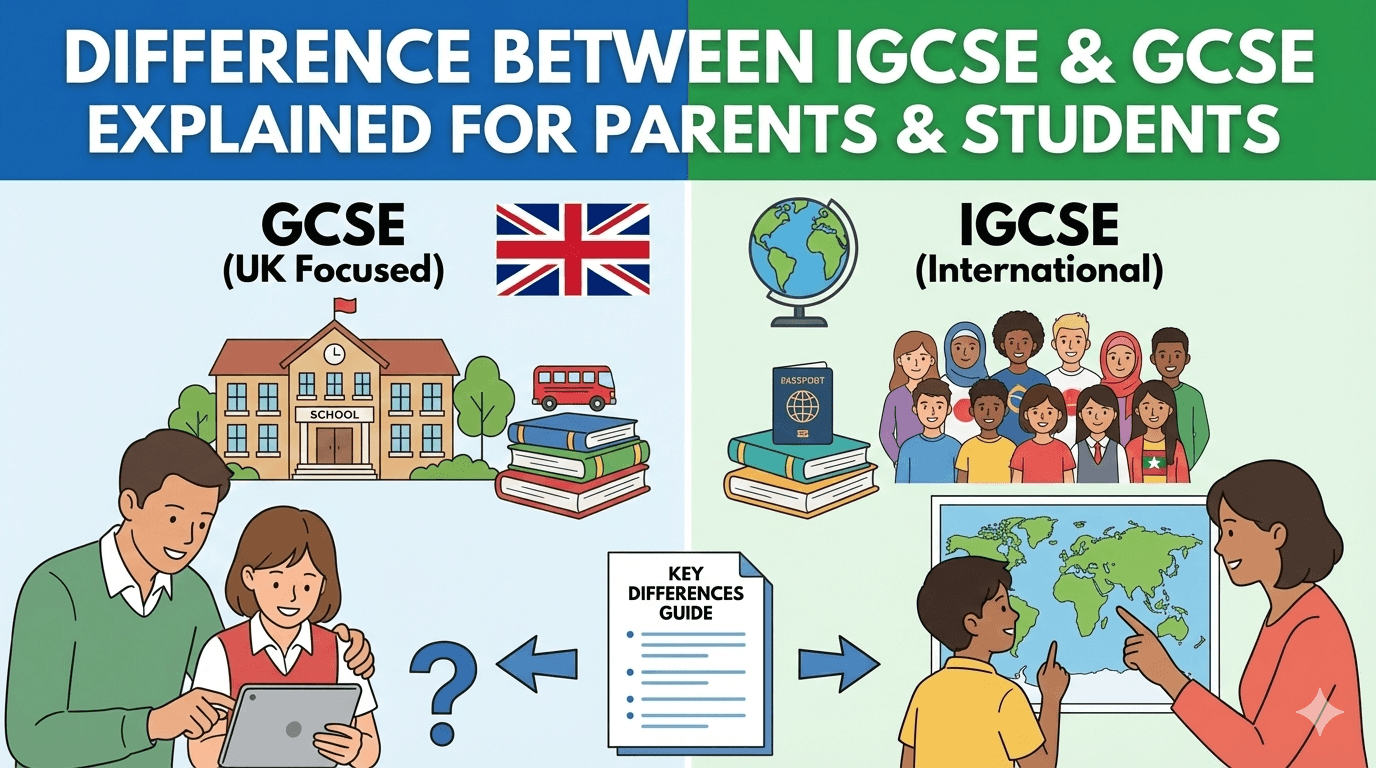
IGCSE and GCSE commonly differ in curriculum focus, assessment style, and global orientation. GCSE is the standard qualification in the UK, while IGCSE offers an international approach recognized by schools and universities globally.
| Feature | IGCSE | GCSE |
| Curriculum Focus | International, flexible | UK national curriculum |
| Assessment | Mix of coursework and exams | Mainly final exams |
| Grading | A*–G or 9–1 depending on board | 9–1 grading system |
| University Recognition | Widely recognized globally | Primarily UK-based recognition |
| Subject Choice | Broad options | More fixed options |
What Is GCSE? A Simple Explanation for Parents
GCSE stands for General Certificate of Secondary Education. It is the standard secondary school qualification taken by students in:
- England
- Wales
- Northern Ireland
Students usually study GCSEs between the ages of 14 and 16, typically in Years 10 and 11.
Key Features of GCSE
- Designed specifically around the UK national curriculum
- Offered mainly in UK state schools and some private schools
- Regulated by Ofqual, the UK exams regulator
- Common exam boards include AQA, OCR, and Pearson Edexcel
- Subjects include Maths, English Language, English Literature, Sciences, Humanities, and optional subjects like Art, Geography, or computer science.
GCSE Assessment
- Increased focus on final written exams
- Some subjects still include coursework or controlled assessments
- More structured exam formats with multiple papers
GCSEs are widely respected and form the foundation for A-Levels, vocational qualifications, and apprenticeships in the UK.
What Is IGCSE? How It Differs from the UK GCSE
IGCSE stands for International General Certificate of Secondary Education. It was developed to provide a more internationally flexible alternative to GCSE.
Key Features of IGCSE
- Designed for international and expatriate students
- Offered in over 150 countries worldwide
- Commonly used by international schools and many UK private schools
- Offered by boards such as Cambridge International and Pearson Edexcel International
- Curriculum content is globally focused, not UK-centric
IGCSE Assessment
- Predominantly exam-based
- Less coursework in many subjects
- Exams often test conceptual understanding and application
IGCSEs are particularly popular among families who may relocate internationally or who want a qualification that prepares students for the IB Diploma, A-Levels, or international universities.
Curriculum Differences Between IGCSE and GCSE
The main difference between IGCSE and GCSE curricula lies in subject choice, content flexibility, and international relevance. IGCSE offers a wider range of electives and emphasizes global perspectives, while GCSE follows the UK national curriculum with standardized subjects.
To choose the right system, create a subject comparison checklist. Map the child’s preferred subjects against what each curriculum offers, considering both academic interest and potential university pathways. This step helps families make informed decisions on IGCSE vs. GCSE for international students.
Is IGCSE Harder Than GCSE? What Students Actually Experience
IGCSE is not inherently harder than GCSE, but it can feel more challenging due to flexible subject choices, coursework components, and an international focus. GCSE emphasizes standardized exams with a consistent UK curriculum, so difficulty depends on the student’s strengths and learning style.
Useful Tip for Parents:
Observe how a student learns best. If they excel in independent projects and applied tasks, IGCSE may be ideal. If exam performance drives their success, GCSE could be a better fit.
Do Universities Prefer IGCSE or GCSE?
One of the biggest fears parents have is whether choosing IGCSE might limit university options. Fortunately, this concern is unfounded.
Universities in the UK and around the world recognize both GCSE and IGCSE as equivalent qualifications. Admissions teams focus far more on later achievements, such as A-Levels, IB, or foundation programs.
In other words, universities care less about whether a student took GCSE or IGCSE and far more about how well they performed and what they did next.
IGCSE or GCSE: How Parents Can Make the Right Choice
Parents often face the challenge of balancing academic rigor with their child’s strengths. Start by considering subject flexibility, assessment type, and university recognition.
IGCSE allows a broader range of electives and multiple assessment formats, which can benefit students aiming for global universities. GCSE offers a structured curriculum and standardized exams, which help students aiming to continue with A-levels or UK-based education.
Another key factor is how your child responds to exams versus coursework. Students who thrive in independent research and applied projects often excel in IGCSE, while those who perform best under structured exam conditions tend to succeed with GCSE.
FAQs
Q1: Can I switch from GCSE to IGCSE?
Yes, it’s possible to switch, but it requires checking subject availability and grading systems at the new school. Students may need to adapt to IGCSE’s broader curriculum and coursework, especially if moving mid-course.
Q2: Is IGCSE more expensive than GCSE?
IGCSE can be slightly more expensive due to international exam fees and broader subject options. Costs vary by school and exam board, so parents should compare fees when planning.
Q3: Is IGCSE recognized in the UK?
Yes, IGCSE is widely accepted by UK schools, colleges, and universities. It is equivalent to GCSE for admissions, though some schools may require specific subjects for A-level progression.
Q4: Which is better for international students: IGCSE or GCSE?
IGCSE is usually better for international students because of its global recognition, flexible subjects, and assessment variety. GCSE may suit students continuing their education in the UK or those who prefer a structured, exam-focused approach.
Q5: How do IGCSE and GCSE affect university applications?
Universities focus on grades, subject choice, and academic consistency, not the exam type. IGCSE provides an international edge, while GCSE aligns with UK-based universities. Both can lead to strong opportunities if students perform well.
Final Words
The conversation around IGCSE vs. GCSE often creates unnecessary anxiety. Both qualifications are rigorous, respected, and capable of opening doors to excellent opportunities. When parents and students understand the real differences, rather than the myths, the decision becomes far less stressful.
The goal isn’t to choose the “harder” or “more impressive” option. The goal is to choose the one that allows a student to learn confidently, perform well, and grow academically.
Need Expert Guidance?
Choosing between IGCSE and GCSE doesn’t have to be confusing or stressful.
If you want:
- Personalised subject guidance
- Expert academic planning
- Targeted exam preparation for IGCSE or GCSE
Contact The Brilliant Brains, an experienced online tutoring academy, to ensure your child is on the right path from the very start.