Why Most A-Level & IGCSE Revision Fails (And What Works Instead)

QUICK SUMMARY
Students struggle with A-Level and IGCSE revision because most methods focus on memorisation rather than exam technique and how examiners award marks. This guide explains why traditional revision fails and shows how to revise using examiner expectations and past-paper analysis so students can turn effort into higher grades.
WHO THIS GUIDE IS FOR
This guide is for:
- A-Level & IGCSE students who study hard but don’t see results
- Students are stuck at the same grade despite regular revision
- Parents worried that the effort isn’t translating into marks
- Learners preparing for final exams, mocks, or retakes
- Students who want examiner-focused, result-driven revision strategies
Not for:
- Students looking for shortcuts or last-minute cramming hacks
- Those who avoid past papers or feedback altogether
- Anyone expecting grades to improve without changing how they revise
TABLE OF CONTENT
- Why Hardworking Students Still Fail Exams
- The Role of Examiner Insights in Revision
- Smart Revision Strategies Most Students Ignore
- Exam-Board Specific Trap
- Frequently Asked Questions
- Final Words
1: Why Hardworking Students Still Fail Exams
From working with A-Level and IGCSE students across multiple subjects and exam boards, we consistently see the same pattern: students who revise for long hours often plateau at the same grade because their answers do not match examiner expectations. The issue is rarely knowledge gaps alone, but how that knowledge is structured and applied in exam conditions
When a student rereads a textbook or their own notes, the material begins to look familiar. This familiarity is often mistaken for “illusion of competence.” In reality, the brain only recognizes input rather than reproducing it. This is why students often feel confident during revision but “freeze” or find they “don’t know how to start” when faced with a blank exam paper.
1.1: The “Effort vs Results” Paradox
- IGCSE students found that over 60% of high-effort students scored lower than expected due to misaligned revision.
- Students often spend 3–5 hours per day re-reading notes but fail to apply knowledge under timed exam conditions, where most marks are actually won or lost.
2: The Role of Examiner Insights in Revision
Examiner insights commonly come from annual reports and feedback summaries. It provides a “behind-the-scenes” look at how marks are actually awarded, moving beyond the static text of a textbook into practical knowledge.
According to Assessment and Learning in Higher Education, students who engage with examiner feedback develop an understanding of “quality” as defined by the awarding body. This process transforms revision from a passive act of memorization into an active exercise in critical thinking and rhetorical alignment.
2.1: Understanding Mark Schemes Beyond the Surface
A common misconception among students is that a mark scheme is a simple checklist of keywords. To truly understand a mark scheme, a student must distinguish between “content points” and “assessment objectives” (AOs).
Mark schemes also reveal mark distribution, showing which parts of a question carry the highest scoring potential and where students should focus their revision.
2.1.1: The Hierarchy of Assessment Objectives
In most modern curricula, marks are divided into categories. For instance, in a standard humanities or science essay, the distribution might follow a structure similar to:
- AO1 (Knowledge and Understanding): The “what” of the subject.
- AO2 (Application): The “how” the knowledge applies to a specific scenario.
- AO3 (Analysis and Evaluation): The “why” or the critical judgment of the information.
Research notes that top-tier marks are almost reserved for AO3. Yet many students spend 90% of their revision time on AO1. Understanding the mark scheme means recognizing that even a correct answer will fail to achieve a high grade if it lacks the analytical depth required by the higher-order descriptors.
2.2: Repeated Examiner Pitfalls Across Years
Examiner reports are published annually to highlight trends in student performance. Analysis of these reports shows that some errors are systemic rather than incidental.
2.2.1: Failure to “Answer the Question” (ATQ)
The most common complaint from examiners is that students answer the question they wished had been asked, rather than the one on the page. This is often due to “schema interference,” where a student sees a keyword (e.g., “Photosynthesis”) and offloads all stored information without filtering it through the specific command verb of the prompt (e.g., “Evaluate the impact of light intensity…”)
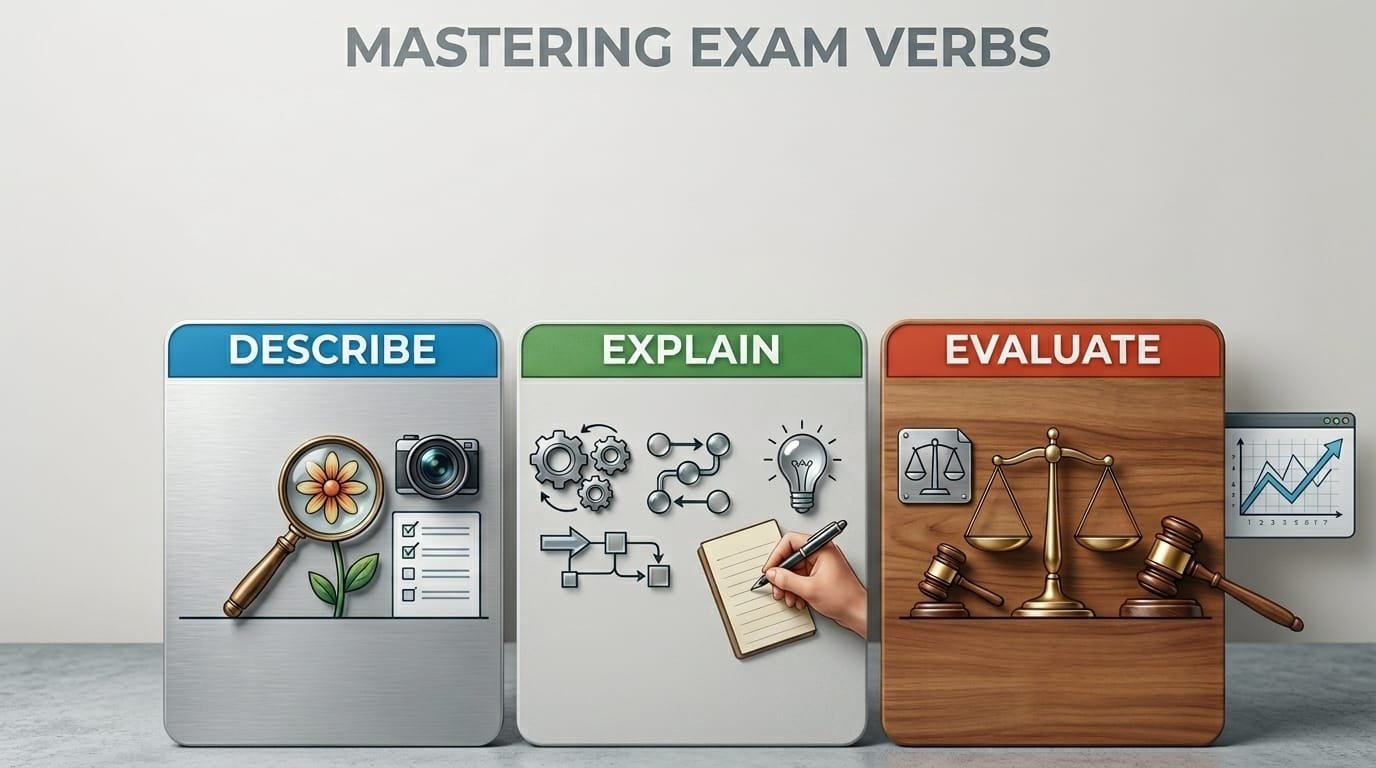
2.2.2: Misinterpretation of Command Verbs
Command verbs are the instructional heart of a question. Common pitfalls include:
- Describe vs. Explain: Students often provide a description (what is happening) when the marks are allocated for an explanation (why it is happening).
- Evaluate vs. Discuss: Evaluation requires a definitive judgment or conclusion, which many students omit, leaving their answer as a mere list of pros and cons.
2.2.3: Poor Time Management and “Question Weighting”
Examiners note that students spends lot of time on low-tariff questions at the beginning of a paper and leave less time for the high-tariff essays at the end. Effective Notetaking suggests that students should use the “marks-per-minute” rule, often calculated as:
Time per Question=Total Minutes/Total Marks Available
3: Smart Revision Strategies Most Students Ignore
These strategies are not theoretical. We apply retrieval practice, spacing, and interleaving deliberately because we see measurable improvements when students revise this way. Students who move from passive reading to structured recall and application typically show faster gains in mock exams within one to two assessment cycles.
3.1: The E.A.M. Framework™ for Maximum Grade Conversion
The E.A.M. Framework (Encoding, Augmentation, and Mastery) aligns with established cognitive principles. The goal is no longer answers, but structured exam answers that directly match examiner expectations.
Encoding:
Encoding is the process of getting information into the memory system. Instead of re-reading, which is a passive activity, students should use “retrieval practice.” This involves recalling facts or concepts from memory without the aid of notes.
Augmentation:
Augmentation involves expanding on the base knowledge. A primary method is “elaborative interrogation,” where the student asks “why” a specific fact or principle is true. By connecting new information to existing mental schemas, the student creates a “web” of knowledge.
Mastery:
Mastery is achieved not by “cramming” but by “spacing.” The Spacing Effect, first identified by Hermann Ebbinghaus, states that information is better retained when study sessions are spread out over time. The mathematical representation of the forgetting curve is often expressed as: R=e−tS
3.2: Active Application vs Passive Reading
Passive reading creates a “recognition heuristic” where the student recognizes the words on the page and confuses that recognition with mastery. Active application, however, requires the brain to reorganize information.
3.2.1: Interleaving vs Blocking
Most textbooks are organized in “blocks” (e.g., Chapter 1, then Chapter 2). But, research in Cognitive Psychology and Its Implications suggests that “interleaving,” mixing different types of problems or subjects in one study session, leads to better long-term retention.
3.2.2: The Feynman Technique
This strategy involves explaining a complex concept in simple terms as if teaching it to a child. If the student hits a “bottleneck” where they cannot explain a step simply, they have identified a gap in their understanding. This aligns with the “Protégé Effect,” where teaching others (or pretending to) enhances the teacher’s own learning.
3.2.3: Dual Coding
To maximize the brain’s processing power, students should use “Dual Coding,” a theory developed by Allan Paivio. This involves combining verbal materials with visual aids. By processing information through two different channels (visual and linguistic), the memory trace becomes more robust.
For example, when studying the Krebs Cycle in biology, a student should both write out the steps and draw the chemical transformations simultaneously.
4: Exam-Board Specific Traps
Having supported students across Cambridge, Edexcel, AQA, and IB pathways, we’ve observed that applying a generic revision method across all boards consistently leads to avoidable mark loss. Each board rewards different assessment behaviours, and revision must adapt accordingly.
Achieving top-tier results requires more than rote memorization. Educational research indicates that students who align their revision techniques with the specific “assessment objectives” (AOs) of their respective boards consistently outperform those who use a generic approach.
Understanding how each board applies grade boundaries helps students prioritise high-impact marks rather than revising everything equally. Below are the strategic adjustments necessary to avoid common pitfalls.
| Exam Board | Primary Pitfall | The Fix |
| Cambridge | Vague terminology / “Waffling” | Use board-specific keywords (e.g., “denature”). |
| AQA | Fragmented points | Build “Chains of Reasoning” with AO3 focus. |
| IB | Knowledge-only bias | Prioritize Critical Thinking (Criterion C) and TOK. |
| Edexcel | Skipping method steps | Document the logical reasoning for every mark. |
4.1: Cambridge IGCSE & A-Level: Precision Over Volume
The University of Cambridge International Examinations (CIE) follows a strict way of testing students. Cambridge focuses on deep understanding, following a tradition called “Tripos.”
4.1.1: The Problem of “Waffling”
A common mistake in Cambridge exams is writing long, descriptive answers where short definitions are needed. In subjects like Biology or Economics, the marking systems are very specific. If a student doesn’t use the exact “keyword” (for example, saying “change” instead of “fluctuation” or “die” instead of “denature” for enzymes), they might not get the mark, even if their explanation is long.
4.1.2: Importance of Command Words
Cambridge is known for its strict rules about command words. For example, “Discuss” means to present a balanced argument, while “Evaluate” means to make a clear judgment based on evidence. Students often lose marks by “describing” when the question asked them to “explain” how something works.
4.2: AQA: Chains of Reasoning
The Assessment and Qualifications Alliance (AQA) is the largest provider of academic qualifications in the UK. Their marking philosophy, especially in Humanities and Social Sciences, focuses on the “Chain of Reasoning.”
4.2.1: The Fragmentation Trap
In AQA Psychology, Sociology, or English Literature, students earn marks for “AO3” (Analysis and Evaluation). A common mistake is listing several separate points of evaluation. AQA examiners prefer “developed” points, where a student takes one idea and explains it fully, using phrases like “consequently,” “this leads to,” or “by extension.”
4.2.2: Level-Based Marking
Unlike CIE’s point-based marking, AQA uses “Levels of Response” grids. A student might mention ten correct facts but still stay in “Level 1” if they don’t connect those facts into a clear argument. The mistake is thinking that having more information will get a higher grade. In reality, a focused essay with three strong paragraphs will score better than a long six-page essay that lacks deep analysis.
4.3: IB: Depth, Analysis, and Assessment Objectives
The International Baccalaureate (IB) Diploma Programme is distinct in its holistic approach, governed by the “IB Learner Profile.” The primary trap in the IB is ignoring the specific weighting of Assessment Objectives.
4.3.1: The “Knowledge Only” Bias
IB students often spend 90% of their time learning content (AO1) but find that the exam allocates 50% or more of the marks to Analysis (AO2) and Evaluation (AO3). In the Internal Assessment (IA) and Extended Essay (EE), the “Criterion-Based” marking means that even a brilliant essay can fail if it does not explicitly address “Criterion C: Critical Thinking.”
4.3.2: The Theory of Knowledge (TOK) Integration
A unique IB trap is failing to recognize the “TOK” element in subject-specific exams. In subjects like History or the Sciences, examiners look for an awareness of the nature of knowledge. How do we know what we know, and what are the limitations of the methodology used?
5: Frequently Asked Questions
5.1: Why do I study hard but still get low marks in A-Level or IGCSE exams?
Students lose marks not because they lack effort, but because their revision does not match how examiners award marks. Passive methods like rereading notes and memorising content do not train application, structure, or command-word accuracy, which are essential for scoring highly.
5.2: What is the most effective way to revise for A-Level and IGCSE exams?
The most effective revision method is examiner-aligned practice. This includes analysing mark schemes, practising timed past-paper questions, identifying recurring mistakes, and correcting weak areas systematically.
5.3: Should revision be different for Cambridge, Edexcel, AQA, and IB?
Yes. Each exam board prioritises different marking criteria. Cambridge rewards precision and context, Edexcel rewards method steps, AQA rewards chains of reasoning, and IB rewards depth and alignment with assessment objectives. Revision should match the marking style of the specific board.
6: Final Words
This is the approach we use with our students at The Brilliant Brains. We don’t increase study hours or overload students with more content. Instead, we refine exam technique, diagnose mark-loss patterns, and align revision with how examiners actually award grades. When the method changes, performance follows.